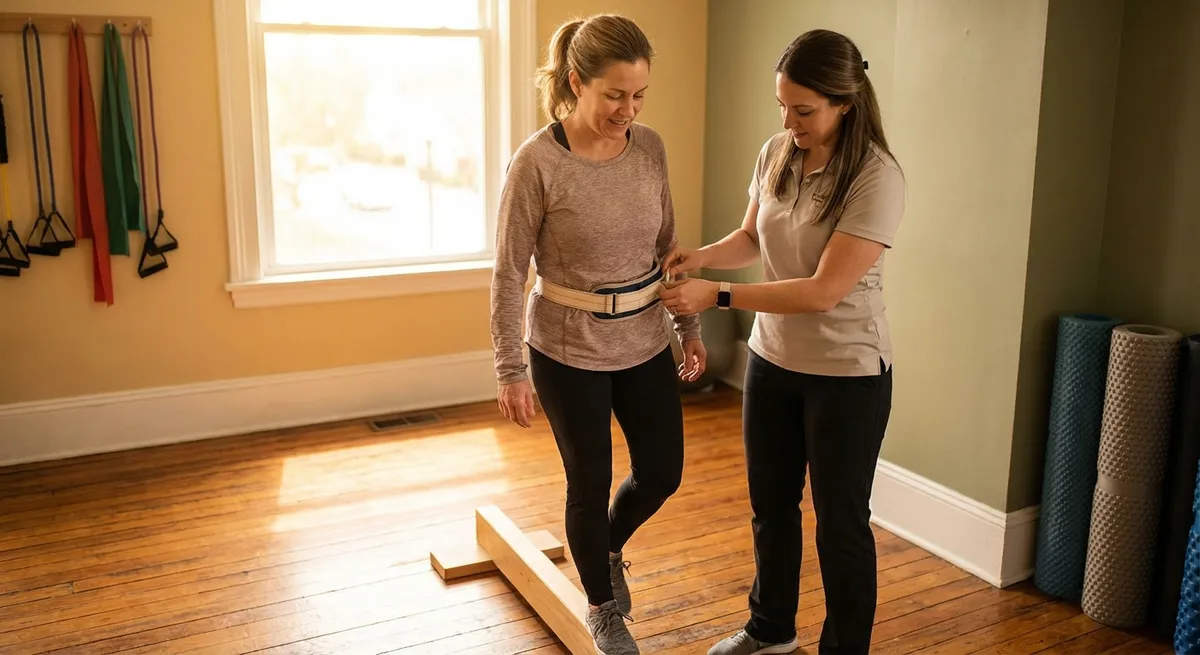
This article is here to help you feel more grounded in that process—with five realistic, kind-to-yourself wellness tips you can actually use in daily life.
Reframing PT: From “Fixing” Your Body to Working With It
Physical therapy often gets framed as something you do only when you’re “broken.” But your body isn’t a project gone wrong—it’s a living system that’s been carrying you through more than you probably give it credit for.
Instead of asking, “What’s wrong with me?” try gently shifting toward, “What does my body need today?” This reframing can change how you experience PT:
- Your home exercises become less like punishment and more like care rituals.
- Progress is measured in moments (less stiffness getting out of bed, one less pain flare) instead of perfection.
- You start noticing small wins, like needing fewer breaks or feeling more stable on stairs.
PT works best when it’s a collaboration. Share openly with your therapist about what scares you, what hurts, and what matters most: playing with your kids, walking your dog, lifting groceries without bracing for pain, or just feeling safe in your body again. Your goals deserve to shape your plan.
Tip 1: Build a “Good Enough” Routine Instead of a Perfect One
A big barrier in PT is the all-or-nothing mindset: “If I can’t do every exercise exactly as prescribed, what’s the point?” That mindset can quietly push you away from progress.
Instead, try a “good enough” approach:
- Aim for consistency over intensity. Doing 5–10 minutes most days often beats pushing hard once and then crashing.
- If the full set feels overwhelming, pick one or two key exercises and focus on those.
- Pair PT exercises with existing habits—after brushing your teeth, during a TV show, while your coffee brews.
You can also talk to your therapist about a “minimum” version of your program for tougher days. That might mean fewer reps, shorter holds, or more rest breaks. Doing a little—kindly and consistently—still counts. In fact, it often matters more than doing it “perfectly.”
Let yourself celebrate showing up, even if the session was short. “I did something for my body today” is powerful.
Tip 2: Learn Your Body’s “Yellow Lights” (Not Just Red Flags)
Many people in PT worry: “If it hurts, am I making it worse?” That fear can lead to either stopping everything or pushing through pain that actually needs attention.
Think of your body like a traffic light:
- Green light: Mild discomfort, muscle fatigue, gentle stretching sensations that ease after you stop.
- Yellow light: Increasing pain, lingering soreness that lasts into the next day, swelling, or feeling unsteady. This doesn’t always mean “stop forever,” but it does mean “slow down, modify, or check in.”
- Red light: Sharp, sudden, or worsening pain, new numbness or tingling, unexpected weakness, or anything that feels alarming. This is a “pause and talk to your PT or medical provider” situation.
Ask your therapist to help you define what your yellow and red lights look like, based on your condition. Knowing that some discomfort can be normal while healing—and knowing where the line is—can help you feel safer, braver, and more in control during your exercises.
Your body is not the enemy. It’s a messenger. Learning to interpret its signals is a skill you can build over time.
Tip 3: Make Recovery Visible So You Don’t Miss Your Own Progress
Healing doesn’t always look dramatic. Sometimes progress is quiet and easy to overlook—especially when you still have pain or limitations. To stay motivated, try making your recovery visible:
- Track small changes: Write down things like “stood at the sink 5 minutes longer,” “got off the floor more easily,” or “woke up with less stiffness.”
- Use simple ratings: Once a day, rate your pain, sleep, or energy on a 0–10 scale. Over weeks, these numbers can show you patterns you might not feel day to day.
- Capture movement milestones: Notice when a motion that used to feel scary or impossible becomes slightly easier, even if it’s not perfect yet.
Bring these notes to your PT sessions. Your therapist can help you connect the dots between what you’re doing and how your body is responding. Sometimes you’re making more progress than your brain wants to admit—and seeing that in writing can be deeply validating.
You deserve to witness your own growth, not just push for the next milestone.
Tip 4: Let Rest Be Part of the Treatment, Not a Sign of Failure
Healing tissue—whether it’s muscle, tendon, ligaments, or nerves—needs two things: the right kind of challenge and the right amount of recovery. Many people try to “push through” PT, then feel discouraged when fatigue or pain spikes.
Instead, treat rest as an actual tool:
- Schedule rest days or lighter days into your routine, not just when you crash.
- Use short breaks between sets—10 to 60 seconds can let your nervous system reset.
- Support your recovery with basics: hydration, nourishing food, and as much quality sleep as you can reasonably manage.
If you notice that certain exercises leave you extremely sore or exhausted for days, tell your therapist. Your program may need adjustments in load, frequency, or type of activity. Progress in PT is not about how hard you can push; it’s about how well your body can respond and adapt.
Rest does not mean you’re giving up. It means you’re allowing your body the space it needs to heal.
Tip 5: Build a Support System Around Your PT Journey
You don’t have to carry your recovery alone. In fact, having support can make it easier to stay consistent and more emotionally grounded when progress feels slow.
Consider:
- Sharing your goals with a friend, partner, or family member and asking them to check in gently about how it’s going.
- Inviting someone to be your “accountability buddy”—not to pressure you, but to remind you that your health matters.
- Talking honestly with your PT about your fears, frustrations, or mental-health struggles related to pain or mobility changes.
- Joining communities, online or in-person, where people are navigating similar conditions. Sometimes just hearing, “Me too,” takes some of the weight off.
You are not “too much” for needing help. Recovery often asks for emotional support, not just physical effort. Let people stand beside you while you do the hard, brave work of healing.
Conclusion
Physical therapy is about so much more than sets and reps. It’s a process of learning to trust your body again, honoring your limits while gently expanding them, and choosing—even on hard days—to keep showing up for yourself.
Your progress might not be linear. Some weeks you’ll feel strong and hopeful; other weeks, everything will feel heavier. Both are part of the journey. What matters is not perfection, but persistence wrapped in self-compassion.
As you move forward, remember:
- A “good enough” routine is still progress.
- Listening to your body is a strength, not a setback.
- You are allowed to rest.
- You do not have to navigate this alone.
Every time you choose to care for your body—even in small, quiet ways—you are moving toward a version of yourself that feels more supported, more capable, and more at home in your own skin. That matters more than you know.
Sources
- American Physical Therapy Association (APTA) – Benefits of Physical Therapy - Overview of how PT supports recovery, pain management, and function
- Mayo Clinic – Physical Therapy and Rehabilitation Overview - Explains what to expect from PT and how it helps with different conditions
- Cleveland Clinic – Pain Management: Acute vs. Chronic Pain - Helps clarify pain types and why listening to your pain signals matters in rehab
- National Institutes of Health (NIH) – Rehabilitation Research Overview - Describes how rehabilitation, including PT, supports recovery and long-term function
- Johns Hopkins Medicine – The Importance of Sleep in Healing - Details how rest and sleep support tissue repair and overall recovery