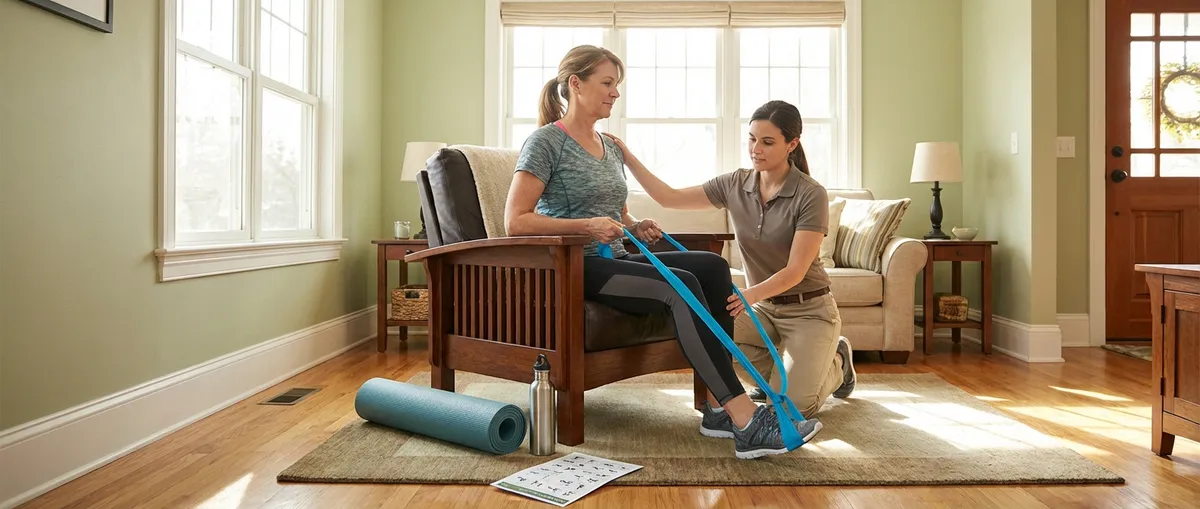
This guide shares five supportive wellness tips you can weave into your physical therapy journey. They’re meant to help you feel a little more grounded, a little more hopeful, and a lot more confident that progress—even slow, wobbly, imperfect progress—is still progress.
Making Physical Therapy Fit Your Real Life
Physical therapy often works best when it actually fits into your life, not when it asks you to become a completely different person overnight. That means it’s okay if your routine doesn’t look like anyone else’s. Maybe you’re balancing work, caregiving, fatigue, or ongoing pain. Maybe you only have a few good windows of energy in a day. That all matters—and it’s worth honoring.
A helpful starting point is to be radically honest with your physical therapist about what your days really look like. Share when your pain tends to spike, what kind of movement feels safest, and what stops you from doing your exercises (like time, energy, or fear of making things worse). This isn’t complaining; it’s key information.
The more your therapist understands your reality, the more they can tailor exercises, frequency, and intensity to something you can actually keep doing. A plan that feels realistic is far more powerful than a “perfect” plan that only lives on paper.
Tip 1: Turn “All or Nothing” Into “A Little Is Still Worth It”
It’s easy to think that if you can’t do the full set of exercises, it’s not even worth starting. That all-or-nothing thinking can quietly stall your progress.
Instead, try this mindset shift: “Something is better than skipping everything.” If your plan says 3 sets of 10 reps and you can only manage 1 set of 6 today, that’s still training. Your muscles, joints, and nervous system still get the message: “We’re working on this.”
You might:
- Do a shorter session in the morning and another in the evening.
- Reduce the number of repetitions but keep the movement quality high.
- Pick just two key exercises on bad days instead of the whole list.
Over time, these smaller efforts begin to layer together. Your body doesn’t demand perfection; it responds to consistency. Even low-volume, steady movement can improve strength, mobility, and confidence when it becomes part of your weekly rhythm.
Tip 2: Use Pain as Information, Not a Punishment
Many people worry: “If it hurts, I must be doing damage.” That fear can lead to doing nothing—or pushing way too hard to “power through.” Physical therapy lives in the space between those two extremes: listening to pain without letting it run the entire show.
A useful idea many therapists use is the “pain scale” or “traffic light” approach:
- Green zone: Mild discomfort (0–3 out of 10) that eases after or during movement. This is often okay and sometimes expected as your body adapts.
- Yellow zone: Moderate pain (4–6 out of 10), or pain that lingers longer than a few hours. This is a signal to adjust form, reduce intensity, or take longer rest.
- Red zone: Sharp, sudden, or severe pain (7–10 out of 10), or pain that changes your breathing, makes you limp, or feels unstable. This is a sign to stop and contact your therapist or provider.
Instead of judging yourself—“I’m weak, I can’t handle this”—try asking, “What is this pain trying to tell me?” Sometimes it’s asking for a form adjustment. Sometimes it’s asking you to slow down. And sometimes it’s reminding you that healing is a process, not a straight line.
Bringing these observations back to your physical therapist can help them fine-tune your plan so you feel safer while still moving forward.
Tip 3: Build Micro-Routines Into What You Already Do
You don’t have to carve out an hour a day in a perfectly calm room to support your recovery. In fact, small “micro-routines” attached to daily habits can be incredibly powerful and sustainable.
Think of simple ways to stack new actions onto routines you already have:
- While brushing your teeth, practice single-leg balance (holding onto the sink for support if you need it).
- After you finish your morning coffee, do two key strength exercises from your program.
- Each time you stand up from your chair, pause and practice controlled sit-to-stand movements, turning a basic motion into a strength exercise.
- During TV time, work in gentle stretches or ankle pumps instead of staying completely still.
These little anchors help your exercises feel less like another item on your to-do list and more like a natural part of your day. Over time, that regular repetition strengthens not only your muscles but also the habit of showing up for yourself.
Tip 4: Track Wins You Can’t See in the Mirror
Healing is often easier to notice when you’re looking for more than just “pain gone” or “full strength back.” If those are your only measurements, you might miss the dozens of quiet improvements happening in the background.
Try keeping a small notebook or note app where you track:
- Tasks that feel easier now (like getting in and out of the car, walking to the mailbox, or carrying groceries).
- Movements that are less scary than they used to be (like stairs, bending, or reaching overhead).
- Changes in energy or confidence (for example, “I walked a little further today without worrying I’d regret it later.”).
- How long a pain flare lasts now versus a month ago.
These “invisible” wins are real and meaningful. They show your nervous system is adapting, your coordination is improving, and your body is slowly relearning what it can do.
When motivation dips (and it will, sometimes), looking back at your notes can remind you of progress you would have forgotten without writing it down.
Tip 5: Protect Your Energy Like It’s Part of Your Treatment
Recovery doesn’t just demand effort—it also requires energy. When you push so hard that you’re completely wiped out for days, it can be harder to stay consistent. Energy management is not laziness; it’s a skill.
Consider:
- Pacing your activities: Break bigger tasks into smaller chunks with rest in between, so you don’t spend all your energy in one burst.
- Planning your exercises during the time of day you usually feel your best—maybe late morning or early afternoon.
- Alternating intensities: Follow a harder PT day with a lighter day focused on gentle mobility or walking, if your therapist agrees.
- Protecting sleep as a non-negotiable. Healing tissues, mood, pain tolerance, and motivation are all impacted by sleep quality.
If you notice that therapy sessions leave you so drained you can’t function afterward, bring that up with your provider. Adjusting frequency, intensity, or exercise selection can help your program support your life instead of overwhelming it.
Learning to value your limits doesn’t slow your progress—it often makes it more sustainable.
Conclusion
Physical therapy isn’t just about exercises; it’s about rebuilding trust between you and your body. That trust grows through small, steady choices: doing what you can on tough days, using pain as information, weaving movement into daily life, noticing quiet wins, and honoring your energy.
You don’t have to do this perfectly. You only have to keep showing up in ways that are kind, realistic, and repeatable. Every time you choose one helpful action—no matter how small—you’re teaching your body and mind the same message: I’m still in this. I’m still moving forward.
And that, truly, is what healing looks like.
Sources
- American Physical Therapy Association (APTA) – What Is Physical Therapy? – Overview of physical therapy, what PTs do, and how treatment plans are created
- Cleveland Clinic – Physical Therapy: Benefits, What to Expect & Type – Explains benefits of PT, common approaches, and patient expectations
- Mayo Clinic – Chronic Pain: Symptoms & Causes – Background on pain, including why pain doesn’t always equal damage
- Centers for Disease Control and Prevention – Physical Activity Basics – Guidance on physical activity and how gradual, consistent movement supports health
- Harvard Health Publishing – The Importance of Pacing Yourself – Discusses pacing strategies and energy management for people living with pain