This is your reminder: you don’t have to be “further along” to deserve support. You’re allowed to show up exactly as you are, with the energy, pain levels, and emotions you have today.
Rethinking PT: It’s Not About Perfection, It’s About Function
Many people picture PT as a place where you’re expected to “push through,” be tough, and hit perfect form from day one. In reality, good physical therapy is much more gentle, collaborative, and human than that.
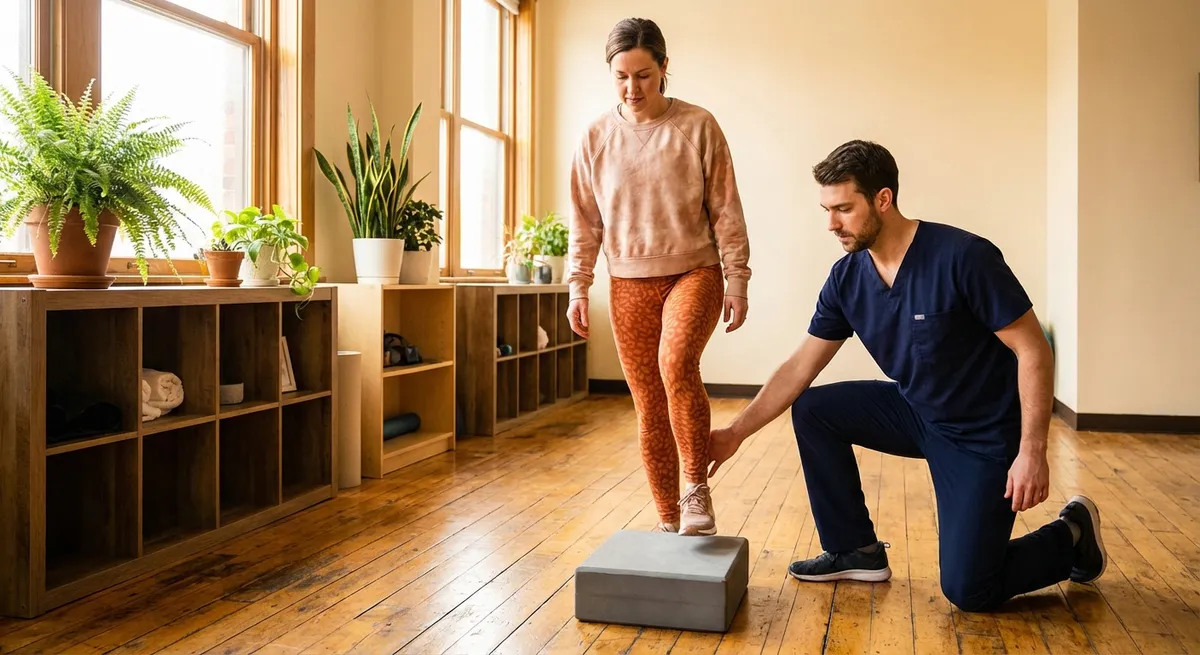
A PT’s job is to help you move in ways that support the life you want to live—whether that’s walking the dog without limping, sitting through a workday without back pain, or playing on the floor with your kids or grandkids. Sessions are meant to be adapted to your energy, your pain, and your real-world responsibilities.
If you’ve ever felt embarrassed about your fitness level, worried you’ll “fail” PT, or ashamed of needing help at all, you’re not alone. A lot of people carry those feelings into their first appointment. What matters is that you showed up. That step alone is a form of strength.
As you move through PT—whether you’re just starting or already in the middle of a plan—try to measure progress in terms of comfort, confidence, and function, not just how “strong” or “fit” you look on the outside. Every time you listen to your body and respect its limits, you’re building a healthier relationship with movement.
Wellness Tip 1: Let Your Body Set The Pace, Not The Timeline
Healing rarely follows a straight line. One day you might feel almost “back to normal,” and the next day the same movement might feel impossible. That doesn’t mean you’re failing—it means your body is healing on its own schedule.
Instead of asking, “How fast can I get this over with?” try asking, “What pace actually feels sustainable for my body and my life?” Then talk honestly with your physical therapist about:
- How many exercises you can realistically do on most days
- When your pain tends to spike (mornings, evenings, after work)
- How sleep, stress, work, and caregiving affect your symptoms
Together, you can create a plan that fits the rhythm of your life instead of expecting your life to bend around a rigid rehab schedule.
Small shifts like reducing the number of repetitions, breaking exercises into mini-sessions, or focusing on fewer, more targeted movements are not “quitting”—they’re customizing. And customized healing usually lasts longer than rushed results.
Wellness Tip 2: Turn Everyday Activities Into Low-Pressure PT
If you’re juggling work, family, and fatigue, adding “one more thing” (like a 30-minute home exercise program) can feel impossible. The good news: a lot of helpful movement can be woven into what you’re already doing.
Here are some gentle ideas you can discuss with your PT and tailor to your condition:
- During toothbrushing, practice standing tall and evenly on both feet, gently engaging your core.
- While waiting for the microwave, try light heel raises or gentle marching in place if it’s safe for you.
- When you sit down and stand up from a chair, do it slowly and with control—this can double as a squat variation.
- At your desk, set a reminder to change position, stretch gently, or walk for 1–2 minutes a few times a day.
These micro-movements may not look impressive, but they add up. Most importantly, they help you connect movement with everyday life instead of treating it like a separate, overwhelming task. That connection can make it easier to stick with PT long term.
Wellness Tip 3: Use Pain As Information, Not A Moral Report Card
Pain can be scary, frustrating, and exhausting. It’s easy to slip into self-blame: “If I’d kept up with my exercises, I wouldn’t feel like this” or “My body is just broken.” But pain isn’t a judgment on your character or your effort—it’s a message from your nervous system.
In PT, you and your therapist can team up to explore what your pain is trying to tell you:
- Is this pain sharp, sudden, or severe? That may be a signal to stop and modify.
- Is it more of a stretch, mild soreness, or a “working” feeling that eases afterward? That may be safe, even if it’s uncomfortable.
- Does pain show up later in the day rather than during the exercise itself? That can be a clue your body needs shorter or lighter sessions.
Learning to label pain as “information” instead of “proof I can’t do this” can calm some of the fear around movement. With guidance, you’ll start to notice patterns—what helps, what hurts, what’s just new—and make more confident decisions about how and when to move.
You’re not weak for having pain. You’re wise for learning how to listen to it.
Wellness Tip 4: Build A Support Team, Not Just A Treatment Plan
Recovery is easier when you don’t feel like you’re doing it alone. While your PT is a key part of your team, you’re allowed to invite in more support—practical, emotional, and social.
Consider:
- A check-in buddy: Someone you can text after appointments or on tough days just to say, “Today was hard, but I showed up,” and hear, “I’m proud of you.”
- A movement partner: A friend, partner, or family member who can walk with you, stretch with you, or simply keep you company while you do your exercises.
- Mental health support: Chronic pain, injuries, and long recoveries can affect mood and motivation. If you can access counseling or a support group, it can make a real difference.
- Boundary protectors: People who respect when you say, “I can’t lift that today,” or “I need to sit down,” and don’t pressure you to “push through.”
You don’t need a huge social circle—sometimes one safe person who believes you and believes in you can change the entire feel of your healing journey.
Wellness Tip 5: Celebrate The Subtle Wins Your Old Self Would Miss
Our culture tends to celebrate big, dramatic comebacks and overlook quiet progress. But in PT, most of the meaningful shifts are small, gradual, and easy to dismiss if you’re not looking for them.
You might not be running yet, but:
- Maybe you got through a work meeting with less shifting in your chair.
- Maybe you walked from the car to the store with fewer stops.
- Maybe you slept a little better because your body felt a bit more settled.
- Maybe you noticed that an exercise that once felt impossible is now just “hard.”
These are wins. Real ones. They are signs that your nervous system, muscles, and joints are learning new patterns.
Try keeping a simple “body wins” note in your phone or journal. Once a day or a few times a week, jot down one thing—no matter how small—that felt a bit easier or more manageable. When frustration hits (and it will), you’ll have proof that your effort is doing something, even if you can’t see the full picture yet.
You’re not just rebuilding movement—you’re rebuilding trust with your body.
Conclusion
Physical therapy isn’t a test you pass or fail. It’s a partnership between you, your body, and your care team, shaped around the life you want to live—not some imaginary ideal.
You are allowed to move slowly. You are allowed to have off days. You are allowed to ask for modifications, for encouragement, and for breaks. Those choices aren’t signs of weakness; they’re signs that you’re healing with awareness, not aggression.
Even if today’s step is tiny—a single exercise, a short walk, or just making that next PT appointment—it still counts. You’re showing up for your future self in a way that is gentle, honest, and brave. And that is a powerful way to heal.
Sources
- American Physical Therapy Association (APTA) – About Physical Therapy - Overview of what physical therapists do and how PT supports function and daily life
- Mayo Clinic – Chronic Pain: Symptoms and Causes - Explains how pain works in the body and why long-lasting pain is complex
- Cleveland Clinic – Physical Therapy: What It Is & Benefits - Details the goals, benefits, and expectations of PT across different conditions
- National Institutes of Health (NIH) – Mind and Body Approaches for Chronic Pain - Discusses the role of supportive, whole-person strategies in managing pain
- Harvard Health Publishing – The Importance of Staying Active When You Have Pain - Reviews evidence on gentle activity, pacing, and function-focused movement during recovery